

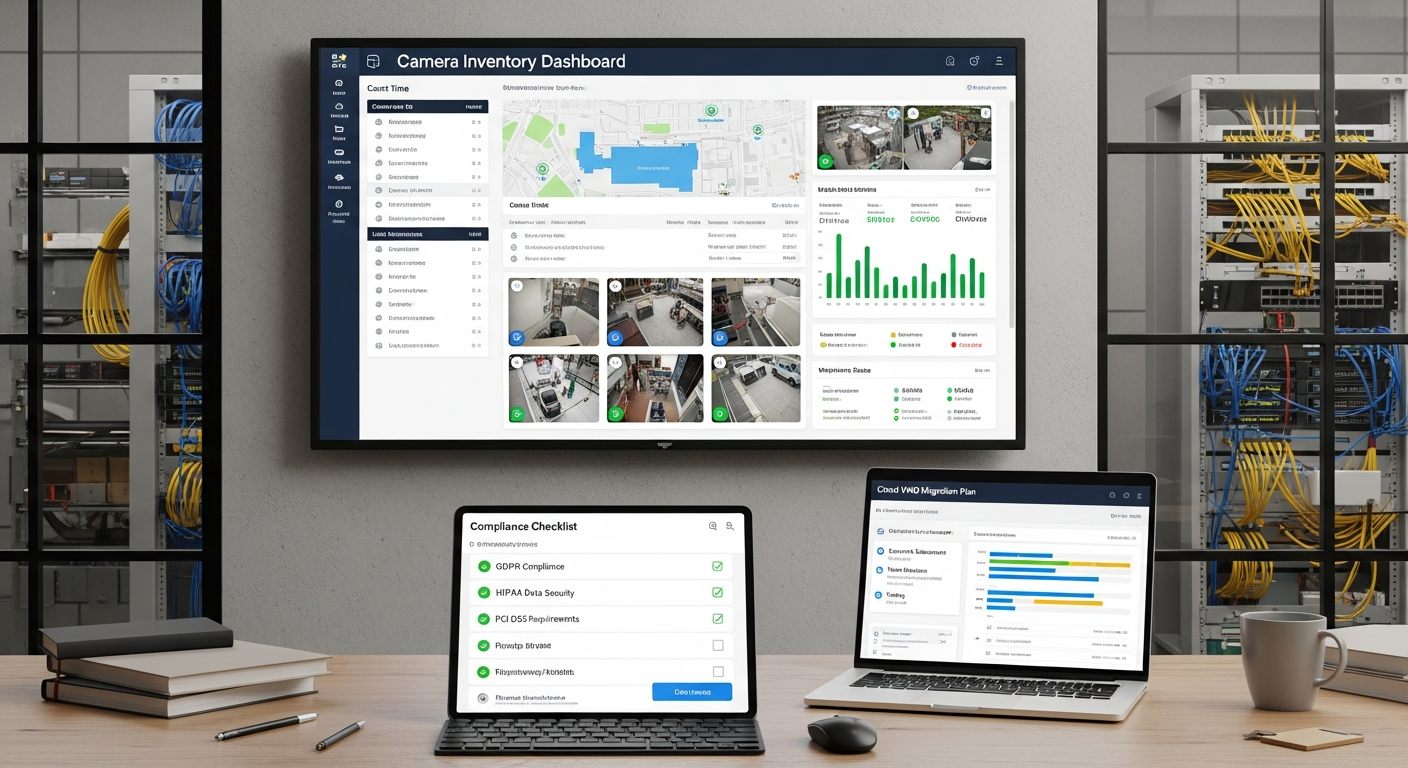
NDAA Section 889 is not a suggestion for federal contractors. It is a procurement requirement that affects your ability to hold and compete for federal contracts. If your organization contracts with the federal government and has Hikvision, Dahua, Huawei, ZTE, or Hytera surveillance equipment in your facilities, you have compliance obligations that require action — not just evaluation.
This page explains what NDAA Section 889 requires, who is affected, what the compliance timeline looks like, and how iFovea fits into a compliance-aware migration plan. It also explains clearly what iFovea cannot do — because getting this wrong has real contractual consequences.
What NDAA Section 889 Means for Video Surveillance Buyers
The National Defense Authorization Act for Fiscal Year 2019 included Section 889, which established two distinct prohibitions:
Part A: Federal Agency Procurement Ban
Federal agencies are prohibited from procuring or obtaining equipment or services from covered companies. This includes video surveillance cameras, network video recorders, related software, and services. The covered companies are: Huawei Technologies, ZTE Corporation, Hytera Communications, Hangzhou Hikvision Digital Technology, and Dahua Technology — and their subsidiaries and affiliates.
Part B: Federal Contractor Use Ban
Federal contractors are prohibited from using covered equipment or services as a substantial or essential component of any system, or as critical technology as part of any system, when doing business with the federal government. This is the provision with the broadest reach — it applies to the contractor’s own facilities and operations, not just the equipment it delivers to the government.
Part B requires contractors to conduct a “reasonable inquiry” — a review of information already in their possession — to determine whether covered equipment is in use. Contractors must certify compliance through representations in SAM.gov. Discovering covered equipment after certification requires reporting within one business day.
Current compliance deadline: Extended to December 2026. This deadline extension gives contractors additional time to identify and replace covered equipment but does not eliminate the obligation.
Who Is Most Affected
Highest Risk
- Defense contractors
- Civilian federal agency contractors
- IT managed service providers with government clients
- Facilities management contractors on federal properties
- Security integrators with government contracts
Moderate Risk
- K-12 schools and universities receiving Title I, E-Rate, or federal grants
- Municipalities receiving federal homeland security grants
- Nonprofits receiving HHS, DOJ, or DHS funding
- Healthcare organizations receiving Medicare/Medicaid
- Public housing authorities receiving HUD funding
Lower / Different Risk Profile
- Private commercial businesses with no federal contracts
- Retail, restaurants, private healthcare
- Residential real estate and HOAs
- Private industrial and manufacturing
- Note: Practical pressures still exist — see below
Why This Applies Beyond the Federal Procurement Boundary
The language of NDAA Section 889 Part B extends to a contractor’s internal use of covered equipment — not just what they procure on behalf of the government. A defense contractor with Hikvision cameras in its own corporate offices, manufacturing facilities, or security operations center may be in violation if those cameras are present while the company holds federal contracts.
This is why the surveillance compliance question is not limited to “what cameras did we install at the government site?” It extends to the contractor’s entire physical infrastructure — and why the “reasonable inquiry” requirement has meaningful operational implications for any organization with government contracting relationships.
The Covered Equipment List
Under NDAA Section 889, the named companies are:
- Huawei Technologies Company or any subsidiary or affiliate of Huawei Technologies Company
- ZTE Corporation or any subsidiary or affiliate of ZTE Corporation
- Hytera Communications Corporation or any subsidiary or affiliate of Hytera Communications Corporation
- Hangzhou Hikvision Digital Technology Company or any subsidiary or affiliate of Hangzhou Hikvision Digital Technology Company
- Dahua Technology Company or any subsidiary or affiliate of Dahua Technology Company
The “subsidiary or affiliate” language is significant for OEM equipment. Many cameras sold under private-label or white-label brands used Hikvision or Dahua manufacturing as their hardware foundation. If the underlying hardware is a Hikvision or Dahua product — regardless of the brand name on the exterior — it may still be considered covered equipment. A thorough compliance review should trace the manufacturing provenance of any cameras in question.
Why iFovea Does Not Make Restricted Cameras Compliant
We want to be explicit about this because other companies in the cloud VMS space are not always clear on it.
Connecting a Hikvision or Dahua camera to any cloud VMS platform — including iFovea — does not change the compliance status of the camera. The camera is still a covered telecommunications equipment product. The VMS platform that manages it does not affect the hardware’s regulatory classification.
A federal contractor using iFovea cloud VMS to manage Hikvision cameras in their corporate facilities is still using covered equipment. The VMS platform is irrelevant to the NDAA Section 889 analysis. The cameras must be removed.
iFovea can provide cloud VMS for NDAA-compliant replacement cameras. That is where we fit in the compliance migration — as the cloud management platform for the new, compliant camera infrastructure, not as a workaround for keeping the restricted cameras.
Compliance-Aware Migration Paths
Path 1: Full Compliance Migration (Required for Federal Contractors)
Identify all covered equipment → document in compliance inventory → replace with NDAA-compliant cameras → deploy cloud VMS for new infrastructure → certify compliance in SAM.gov → document the migration for contractual records.
iFovea supports this path: NDAA-compliant cameras from Axis, Hanwha, Bosch, Uniview, and 500+ other compatible models connect to iFovea cloud VMS. The camera replacement project removes the covered equipment; iFovea becomes the cloud management layer for the new compliant infrastructure.
Path 2: Phased Replacement for Large Deployments
Large deployments with hundreds or thousands of cameras may not be able to complete replacement before the December 2026 deadline without significant disruption. A phased approach — prioritizing highest-risk and most visible covered equipment while demonstrating good-faith compliance progress — should be developed in consultation with legal counsel and contracting officers.
Path 3: Grant-Funded Organization Assessment
Organizations receiving federal grants should review their grant conditions specifically for surveillance equipment requirements. E-Rate funded schools, Homeland Security grant recipients, and similar organizations may face specific restrictions in their grant conditions that predate or extend beyond the NDAA Section 889 framework. Legal review is recommended before any decisions about existing equipment.
Documentation Checklist for Compliance Migration
Compliance Migration Documentation
- ☐ Complete camera inventory with manufacturer, model, serial number, and installation location
- ☐ Identification of covered equipment under NDAA Section 889 definition (including OEM/private-label provenance check)
- ☐ Legal counsel review and written compliance opinion
- ☐ Contracting officer consultation for active contracts
- ☐ Migration timeline with scheduled replacement phases
- ☐ NDAA-compliant replacement camera specifications and procurement documentation
- ☐ SAM.gov representation update upon completion
- ☐ Cloud VMS deployment documentation for replacement infrastructure
- ☐ Network segmentation documentation for interim period if cameras remain during phased replacement
Frequently Asked Questions
Is NDAA compliance required for private businesses with no federal contracts?
NDAA Section 889 Part B specifically applies to entities that contract with the federal government. Private commercial businesses with no federal contracting or federal grant relationships are not currently subject to this specific requirement. However, the FCC equipment authorization ban means new Hikvision/Dahua equipment can no longer be purchased through authorized channels, and private businesses should evaluate cybersecurity and insurance implications separately.
We have a small federal contract. Does that mean every camera in our company must be replaced?
The Part B prohibition applies to covered equipment used “as a substantial or essential component of any system” during the performance of a federal contract. The specific application of this standard to your company’s situation depends on the nature of your contract, your facilities, and how covered equipment is used. This is exactly the kind of fact-specific question that requires legal counsel review. Do not assume the answer without professional guidance.
What counts as a “subsidiary or affiliate” of Hikvision or Dahua?
This is one of the most complex compliance questions in the NDAA Section 889 analysis. The FAR definition covers companies in which Hikvision or Dahua has ownership interests, and extends to OEM products manufactured by covered companies regardless of the brand they’re sold under. A thorough compliance analysis should include checking the manufacturing provenance of cameras — not just the brand name on the housing. Legal counsel should advise on how to conduct this inquiry.
Can iFovea cloud VMS help us manage NDAA-compliant replacement cameras?
Yes. iFovea supports NDAA-compliant cameras from Axis, Hanwha, Bosch, Uniview, Milesight, and hundreds of other ONVIF-compatible manufacturers. Once covered cameras are replaced with compliant hardware, iFovea provides the cloud VMS layer for remote access, AI analytics, multi-site management, and cloud retention. Use the camera compatibility guide to check specific models, and the cost calculator to estimate deployment budget.
How do we handle cameras that can’t be immediately replaced before the deadline?
Organizations that cannot complete replacement before the December 2026 deadline should consult with legal counsel and contracting officers about interim measures, good-faith compliance documentation, and any available waiver or exception processes. Maintaining a documented compliance plan with a credible timeline may be relevant to demonstrating good-faith effort. Do not attempt to manage this situation without professional legal guidance.
Related Resources
- Hikvision, Dahua, and Chinese Camera Restrictions: What Businesses Should Know
- Hikvision and Dahua NVR Replacement With Cloud VMS
- Replace NVR vs. Replace Entire Camera System: Cost Guide
- NDAA-Compliant Camera Compatibility Guide
- Cloud Surveillance Migration Checklist
- FAR 52.204-25: Prohibition on Contracting for Certain Telecommunications (official source)
- FCC Covered List (official FCC resource)
Request a Compliance-Aware Surveillance Migration Review
iFovea can help you assess which of your existing cameras are technically compatible with cloud VMS, estimate the cost of a compliant replacement deployment, and build a migration timeline that works with your contracting obligations.
This review is technical. For legal compliance guidance, consult qualified legal counsel and your contracting officers.