

Direct Answer
What is cloud VMS for retail?
Cloud VMS (Video Management Software) for retail is a cloud-hosted surveillance platform that centralizes all store cameras — across 1 location or 500 — on one dashboard. It includes AI analytics for retail: people counting, heat mapping, loss prevention detection, ALPR for parking, and AI video search for incident investigation. No per-store servers. Works with existing ONVIF cameras (Hikvision, Axis, Bosch, Dahua).
- ✓AI loss prevention: detect suspicious behavior at shelves and exits
- ✓People counting & heat maps: measure traffic and optimize store layout
- ✓Multi-store dashboard: manage all locations from one login — no per-store IT
Industry surveillance solution
iFovea is a cloud-based VMS built for retail – combining cloud camera storage with AI analytics that help you reduce shoplifting, understand customer behavior, and optimize your store layout. It works with your existing cameras from Axis, Hikvision, Uniview, and more. No NVR required. No rip-and-replace.
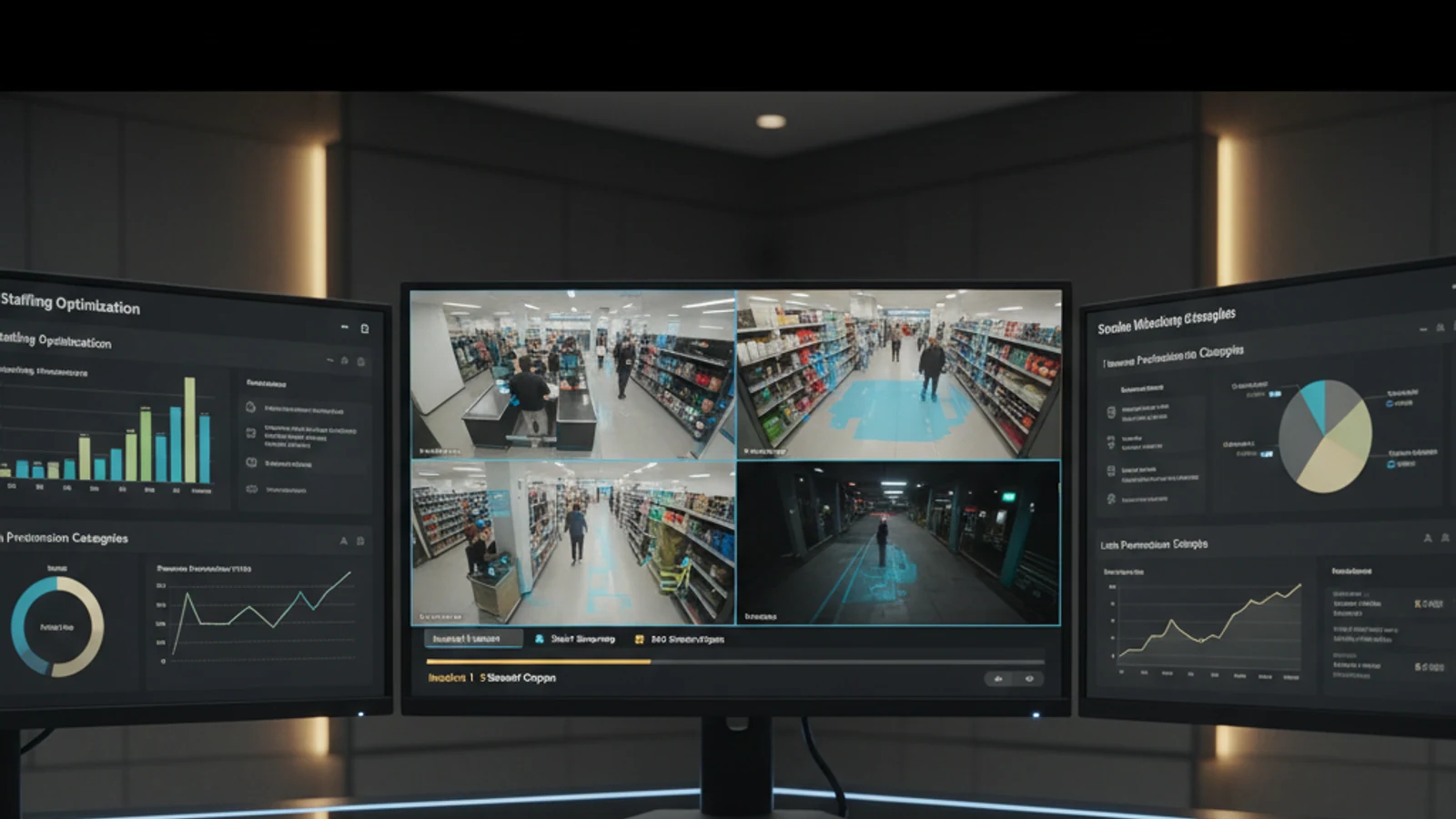
iFovea is a cloud-based VMS built for retail – combining cloud camera storage with AI analytics that help you reduce shoplifting, understand customer behavior, and optimize your store layout. It works with your existing cameras from Axis, Hikvision, Uniview, and more. No NVR required. No rip-and-replace.
Multi-site visibility
Give operations and security teams one place to monitor locations, users, and incidents.
AI-assisted review
Find events faster with video search, analytics, and alert workflows tied to real business needs.
Flexible deployment
Support existing cameras, cloud access, and hybrid recording for practical rollouts.
The Retail Security Problem No One Talks About
Most retail stores have cameras. But those cameras are almost entirely reactive – you check them after a theft occurs, not before or during. The footage exists, but it doesn’t work for you. iFovea changes that by making your cameras proactive: they recognize repeat shoplifters, count foot traffic in real time, show you which zones customers visit most, and alert you when suspicious behavior occurs.
4 Ways iFovea Helps Retail Stores
1. Loss Prevention: Face Recognition That Catches Repeat Shoplifters
iFovea’s face recognition lets you build a watchlist of known shoplifters. When a person on your watchlist enters any of your stores, you get an instant alert – before they have a chance to steal. No more reviewing hours of footage after the fact. Retail shrinkage averages 1.5% of revenue. For a store doing $2M/year, that’s $30,000 gone. AI-powered face recognition is the most direct path to recovering a significant portion of those losses.
2. Foot Traffic Analytics: Know Where Your Customers Actually Go
iFovea’s people counting tracks how many customers enter your store, which departments they visit, and how long they spend in each area. This data reveals:
- Which products get high foot traffic but low purchase rates (visibility problem vs. product problem)
- Which areas of your store customers skip entirely (dead zones to redesign or restock)
- Peak hours for staffing optimization
- Conversion rate by zone (visitors to buyers)
3. Heat Maps: See Your Store Through Your Customers’ Eyes
iFovea’s heat maps generate a color-coded overlay of your store showing exactly where customers spend time. Hot zones are crowded; cold zones are underutilized. Use heat map data to:
- Place high-margin products in high-traffic zones
- Redesign store layouts based on actual behavior, not guesswork
- Identify checkout bottlenecks and queue buildup areas
- Plan end-cap and promotional display placement
4. False Alarm Reduction: AI That Only Alerts on What Matters
Traditional motion sensors trigger on anything that moves – customers, staff, reflections, air conditioning units. iFovea’s object detection identifies specific objects (people, vehicles) rather than raw motion, so you get alerts when a person is in a restricted area after hours – not every time a shopping cart rolls past a sensor.
Turn this into a practical surveillance plan
iFovea can review your camera fleet, sites, bandwidth, AI analytics needs, and migration path.
Works With Cameras You Already Own
iFovea supports IP cameras from the most widely-used retail security brands: Hikvision, Axis, Uniview, Vivotek, Milesight, TVT, Tiandy, and 2M Technology. If your store cameras are from any of these manufacturers, you can connect them to iFovea’s cloud – without replacing a single camera.
Cloud-Based: Access Your Cameras From Anywhere
iFovea stores all footage in the cloud and provides real-time access via browser and mobile app (iOS and Android). District managers can check any store’s cameras remotely. Loss prevention teams can monitor multiple locations from one dashboard. No VPN, no port forwarding, no NVR to maintain.
“Switching to iFovea let us standardize video access across 40 locations without ripping out a single camera. Regional managers can now review incidents remotely in minutes instead of waiting for someone on-site to pull footage.”
Frequently Asked Questions for Retail
Is face recognition legal for retail use?
Face recognition legality varies by jurisdiction. In the US, several states (Illinois, Texas, Washington) have biometric privacy laws (BIPA) that require consent before collecting facial data. Best practice: display clear signage informing customers that face recognition is in use, consult with legal counsel for your specific jurisdiction, and use recognition only for loss prevention purposes (not for general customer profiling). iFovea’s platform gives you full control over watchlist management and data retention.
Do I need to replace my existing cameras?
No. iFovea works with your existing IP cameras from Axis, Hikvision, Uniview, Vivotek, Milesight, and others. The only requirement is that your cameras are IP (not analog/CCTV) and on the compatibility list. For most retail installations built in the past 10 years, existing cameras will work.
How accurate is the people counting?
iFovea uses deep learning-based object detection for people counting. Accuracy depends on camera placement, resolution, and scene complexity. For best results, cameras should be positioned at entry points facing downward at a 45-60 degree angle. For most retail applications, accuracy exceeds 90%.
Can I monitor multiple store locations from one dashboard?
Yes. iFovea’s cloud dashboard supports multi-site management. You can view cameras from all your locations in one interface, set location-specific alert rules, and generate foot traffic reports by store or by district.
How long is footage stored?
Storage duration is customizable per camera. Plans range from 7 days to 90+ days of cloud retention. Each camera can have a different plan based on how much historical footage you need for that location or zone.
Request a Free Retail Demo – See iFovea in Your Store
See face recognition, heat maps, and people counting live on a retail store camera setup. Free demo, no commitment.
Related Industry Pages
Frequently Asked Questions
Can I use existing store cameras with cloud VMS?
Yes. Most IP cameras installed in retail stores in the last 10 years support ONVIF, which connects to iFovea cloud VMS without replacement. Common retail brands: Hikvision (DS-2CD series), Axis (P32 and M30 series), Hanwha (QNO series), and Bosch (Flexidome series) are all ONVIF-compatible. Check your camera model at the camera compatibility checker before deploying.
How does cloud surveillance reduce retail shrink?
Cloud VMS reduces retail shrink through multiple AI-driven mechanisms: real-time zone alerts when customers or staff enter restricted areas (stock rooms, employee-only areas), AI video search that locates any incident in seconds for faster LP investigation, heat maps that identify blind spots in your camera coverage plan, and ALPR in parking areas that associates vehicles with organized retail theft patterns.
Can district managers monitor all stores remotely?
Yes. Multi-site cloud VMS is specifically designed for district and corporate retail oversight. District managers can be assigned to view only their district’s stores; corporate LP sees all locations. Live camera feeds, AI analytics dashboards, and AI video search work across all stores simultaneously from the same browser interface — no per-store logins or VPN connections.
Does cloud VMS work for franchise retail operations?
Yes. Cloud VMS supports franchise structures through role-based access: franchisor corporate can view all franchise locations; individual franchisees can view only their own stores. Each franchisee location adds cameras to the shared platform under their account. Corporate LP can set AI analytics thresholds and alert configurations that apply across all franchise locations. Pricing is per camera per location — scales linearly as the franchise network grows.
What is the cost of cloud surveillance for a 10-store retail chain?
A 10-store retail chain with an average of 8 cameras per store (80 total cameras) at $20/camera/month = $1,600/month or $19,200/year. This includes cloud storage (30-day retention), all 10 AI analytics types, remote access for district managers, and multi-site management. Compare to the NVR alternative: $800 NVR hardware × 10 stores = $8,000 upfront + $200/month IT maintenance + $400/year storage = ~$10,800 first year but $4,800/year ongoing — with no AI analytics.
Can cloud surveillance detect checkout theft or sweethearting?
AI surveillance can flag POS area anomalies: unusual employee behavior at checkout (not scanning items, excessive voids, discount overrides), extended transaction durations, and customers in non-customer areas near checkout. These are proximity and behavioral analytics — not a direct “sweethearting detection” classifier. AI video search lets LP search footage by time window and camera to investigate flagged POS exceptions from your POS system data.
How does cloud VMS handle high-volume retail traffic during holidays?
Cloud VMS AI analytics automatically scale with traffic volume — people counting and heat map analytics process all events regardless of traffic level. The AI alert thresholds can be adjusted seasonally (raising zone-alert sensitivity during high-traffic periods). Video storage costs are fixed per-camera regardless of activity level — no additional charges for high-traffic event volume.
Does cloud VMS integrate with retail POS systems?
iFovea does not have a native POS integration, but cloud VMS complements POS exception reporting: when POS reports flag a suspicious transaction, LP uses the timestamp and register number to pull up the corresponding camera feed in iFovea AI video search and review the transaction in seconds. This POS-plus-VMS workflow is the industry standard for exception-based surveillance review.
What camera coverage is recommended for a retail store?
Standard retail camera coverage: (1) all store entrances and exits, (2) high-value merchandise sections (electronics, pharmacy, cosmetics), (3) POS and customer service areas, (4) stock room and receiving doors, (5) parking lot ALPR at vehicle entry/exit. Minimum recommended resolution: 1080p indoors, 4K or varifocal at entrances for facial clarity. For a 5,000 sq ft store, 6–12 cameras provide full coverage.
Can I test cloud VMS before committing to a retail rollout?
Yes. iFovea supports pilot deployments — start with one or two store locations to validate camera compatibility, AI analytics performance, and remote access workflow before expanding to the full chain. The subscription is month-to-month with no long-term commitment during pilot phase. Most retail pilots are live within 48 hours per location using existing cameras.
Related resources
Continue comparing options, planning migration, and estimating the right cloud surveillance architecture.
Related Platform Features, Industries & Comparisons
Platform features, similar industries, competitor comparisons, and cost tools
Platform Features
Related Industries
Compare Alternatives
Ready to plan the next step?
iFovea can review your camera fleet, sites, bandwidth, AI analytics needs, and migration path.