

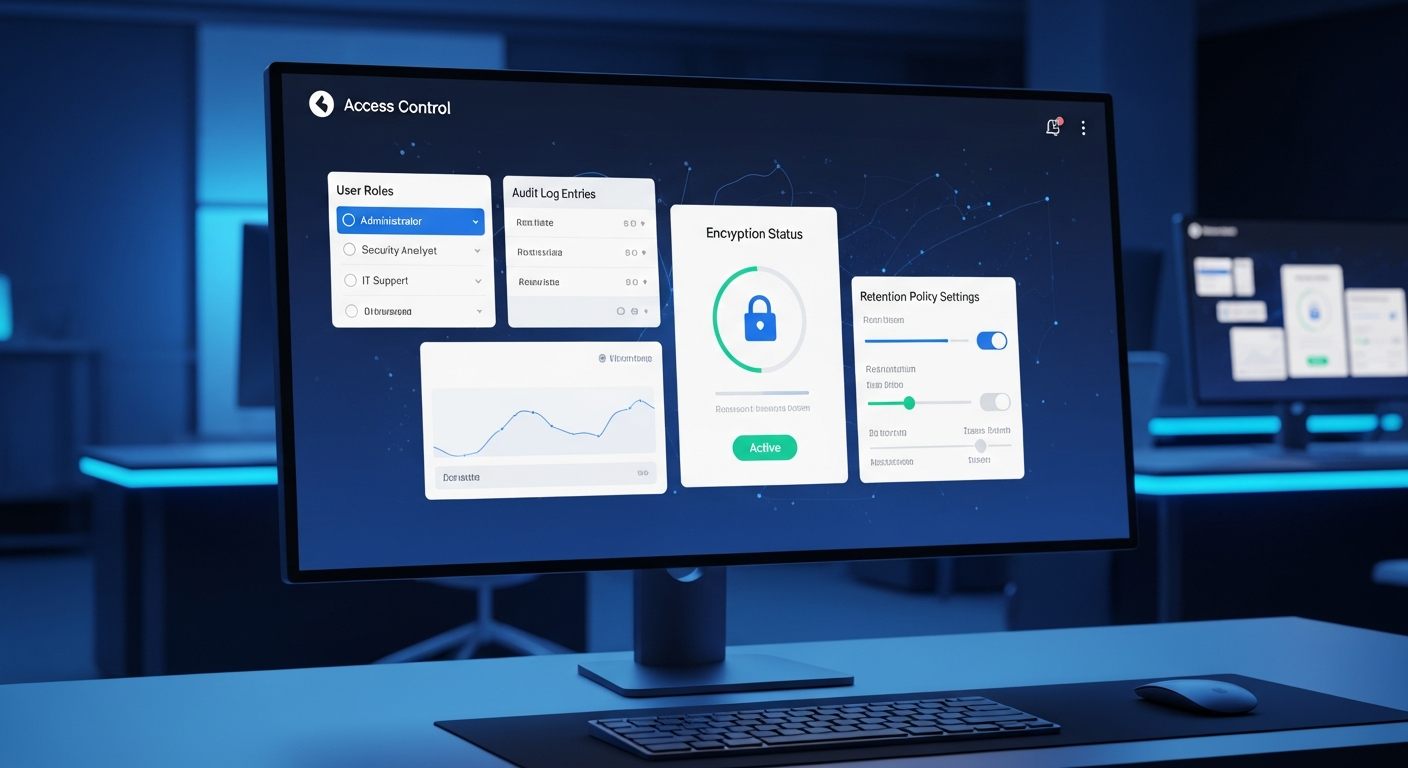
Deploying AI video surveillance in a commercial, healthcare, financial services, or educational environment means operating AI data processing infrastructure that handles personally identifiable information, behavioral data, and security-sensitive footage. The governance and security requirements that come with that are different from anything a traditional CCTV system required.
This page documents iFovea’s security architecture, data protection capabilities, and governance tools that help organizations manage cloud video surveillance in compliance-sensitive environments — covering encryption, access controls, audit logging, retention management, data ownership, and the framework for satisfying regulatory and insurance requirements that increasingly apply to AI surveillance deployments.
iFovea provides the technical infrastructure for security and governance. Every organization should engage legal counsel to review specific regulatory requirements applicable to their jurisdiction, industry, and AI surveillance deployment scope.
Platform Security Architecture
Encryption at Rest and in Transit
Video footage and AI-generated metadata are encrypted at rest using AES-256 encryption. All data transmission between cameras, the iFovea Gateway, and cloud storage uses TLS encryption in transit. Footage stored in the cloud is not accessible without authenticated platform credentials.
Role-Based Access Controls
Granular access controls configurable by user, role, camera group, and location. Users can only access cameras and footage explicitly permitted by their role assignment. Access is enforced at the platform level — not just at the interface.
Multi-Factor Authentication
MFA is supported for all platform accounts and required by default for administrative roles. MFA enforcement is configurable at the organization level through the admin portal. MFA reduces unauthorized access risk even when credentials are compromised.
Comprehensive Audit Logging
Every access event — footage view, AI search, data export, alert configuration change, user provisioning — is logged in an immutable audit trail with user identity, timestamp, and action type. Audit logs are exportable for compliance documentation and SIEM integration.
Configurable Retention Policies
Retention periods are configurable per camera, per location group, or per organization. Footage expires automatically at the configured retention period. Legal hold capability preserves specific footage beyond the standard retention period for litigation or compliance purposes.
Customer Data Ownership
Video footage recorded on your cameras is your organization’s data. iFovea does not claim ownership of customer footage or use customer video data for purposes beyond service delivery. Data ownership terms are specified in the subscription agreement.
Regulatory Environment for AI Video Surveillance
The regulatory landscape for AI video surveillance is evolving rapidly across multiple jurisdictions. Organizations deploying AI-powered surveillance in commercial and workplace environments should be aware of the primary regulatory frameworks that may apply:
Employee Monitoring Disclosure Requirements
Most employment law jurisdictions require employers to notify employees when AI surveillance of work activities is in operation. This typically includes disclosure in employee handbooks, specific notice at the time of AI surveillance deployment, and updated employment agreements where the nature of monitoring changes materially. Requirements vary significantly by state and country — legal counsel review is essential before deployment in any employment context.
Privacy Regulations (GDPR, CCPA, State Laws)
Organizations subject to GDPR, CCPA, or similar privacy frameworks may be required to update their privacy policies to disclose AI video processing as a category of personal data collection, honor data subject access rights for footage and AI metadata where applicable, and document lawful basis for AI video processing. Failure to disclose AI surveillance capabilities is generally treated more seriously than the underlying data collection under these frameworks.
Industry-Specific Requirements
- Healthcare: HIPAA-regulated environments should review AI video surveillance for potential PHI exposure in clinical areas. Camera placement and access controls should be designed to minimize incidental PHI capture.
- Financial Services: FFIEC examination procedures reference physical security documentation standards that imply surveillance footage retention and access logging requirements.
- Education: FERPA considerations apply to surveillance footage that may capture student identifiable information in educational settings. State education codes often specify camera placement and retention requirements.
- Gaming: State gaming regulations typically specify detailed surveillance requirements including coverage areas, retention periods, and access documentation standards.
Data Governance Capabilities
Access Governance
The iFovea platform enables organizations to implement access governance policies that define who can access what footage and AI data, under what circumstances, with what documentation requirements. The role-based access control system and audit logging capability provide the technical enforcement and documentation layer for access governance frameworks. See the admin portal documentation for role configuration details.
Retention Governance
Cloud video storage in iFovea follows configurable retention policies that can be set per camera, per location, or per organization. This enables organizations to implement retention policies aligned with regulatory minimums, insurance requirements, and operational investigation timelines — and to document those policies for compliance purposes. The cloud video storage guide covers retention policy configuration in detail.
Footage Export and Chain of Custody
Footage exported from the iFovea platform is delivered as standard MP4 files with full timestamp metadata. Every export action is logged in the audit trail with user identity, camera, time range, and timestamp — creating chain-of-custody documentation for footage used in insurance claims, legal proceedings, or law enforcement requests.
Legal Hold
The platform’s legal hold capability allows specific footage to be preserved beyond its standard retention period when relevant to anticipated or active litigation. Legal hold actions are logged in the audit trail with the authorizing user and timestamp, and held footage is protected from automatic expiration until the hold is released by an authorized administrator.
What to Verify Before AI Surveillance Deployment
Organizations deploying AI surveillance for the first time — particularly in employment contexts or jurisdictions with active AI regulation — should verify the following before go-live:
| Governance Area | What to Confirm | Who to Involve |
|---|---|---|
| Employee notice | Notice requirements for AI surveillance deployment in your jurisdiction | HR, legal counsel |
| Privacy policy | Whether AI video processing requires privacy policy updates for GDPR/CCPA compliance | Legal counsel, privacy officer |
| Retention policy | Regulatory minimums, insurance requirements, and operational investigation timelines for your industry | Security director, legal, IT |
| Access controls | Defined roles for who can access footage, run AI searches, and export data — and under what authorization | IT director, security director, HR |
| External requests | Process for law enforcement and legal requests for footage and AI metadata | Legal counsel |
| AI capability scope | Which AI features are enabled and their documented permitted use cases | Security director, legal, IT |
Frequently Asked Questions
Does iFovea have SOC 2 certification?
iFovea’s cloud infrastructure is hosted on enterprise-grade cloud infrastructure designed to support SOC 2-level security practices. Organizations with specific certification requirements should request infrastructure security documentation from the iFovea team and confirm that applicable framework requirements are satisfied for their specific compliance environment.
Where is iFovea customer footage stored geographically?
iFovea’s cloud storage infrastructure is hosted in enterprise cloud data centers. Organizations with data residency requirements specific to their jurisdiction or industry should confirm geographic storage location with the iFovea team during the deployment assessment. Contact the team through the demo request form to discuss data residency requirements.
Who can access our footage at iFovea?
Customer footage is accessible only to users with authenticated credentials to the customer’s iFovea account. iFovea staff access to customer footage for support purposes is governed by internal access controls and logged in platform audit records. Customer footage is not used for any purpose beyond service delivery and is not shared with third parties without customer authorization or valid legal process.
Does iFovea support HIPAA compliance for healthcare surveillance?
iFovea provides the technical security infrastructure — encryption, access controls, audit logging, retention management — that organizations may use to implement HIPAA-compatible surveillance deployments. iFovea is not a HIPAA Business Associate in the context of surveillance video. Healthcare organizations deploying AI video surveillance should work with legal counsel to determine whether and how HIPAA requirements apply to their specific surveillance deployment.
How does legal hold work in the iFovea platform?
Legal holds can be applied to specific footage segments through the platform interface by users with appropriate administrator permissions. Held footage is excluded from automatic retention expiration and remains accessible until the hold is explicitly released by an authorized administrator. All legal hold actions — creation, modification, and release — are logged in the audit trail.
Related Resources
- Admin Portal: Access Controls, Audit Logs, and User Management
- Cloud Video Storage: Retention, Encryption, and Data Ownership
- Cloud VMS Platform Guide
- FAQ: Security, Compliance, and Data Ownership Questions
Review iFovea Security and Compliance Capabilities
Request a demo to discuss your organization’s specific compliance requirements and review how iFovea’s encryption, access controls, audit logging, and retention management capabilities support your governance framework.