

Direct Answer
What is cloud surveillance for warehouses?
Cloud VMS for warehouses manages all facility cameras — dock doors, warehouse floor, perimeter, parking — from one cloud dashboard accessible from any device. Warehouse-specific analytics include ALPR at dock and gate entries (automated vehicle logging), perimeter alerts for after-hours activity, and AI video search for cargo incident investigation. Works across multi-facility distribution networks without per-site NVR hardware.
- ✓ALPR at dock doors: automate inbound/outbound truck logging without manual sign-in
- ✓Perimeter alerts: instant notification for after-hours boundary intrusions
- ✓AI video search: investigate cargo damage or shrinkage incidents in under 60 seconds
Industry surveillance solution
Warehouses present one of the most demanding environments for video surveillance: large footprints, limited sightlines, shift-based operations around the clock, high-value inventory at constant risk, and connectivity infrastructure that often lags behind urban commercial properties. Traditional NVR-based systems struggle here – they require hardware at every site, provide no remote visibility, and offer no operational intelligence beyond raw video footage.
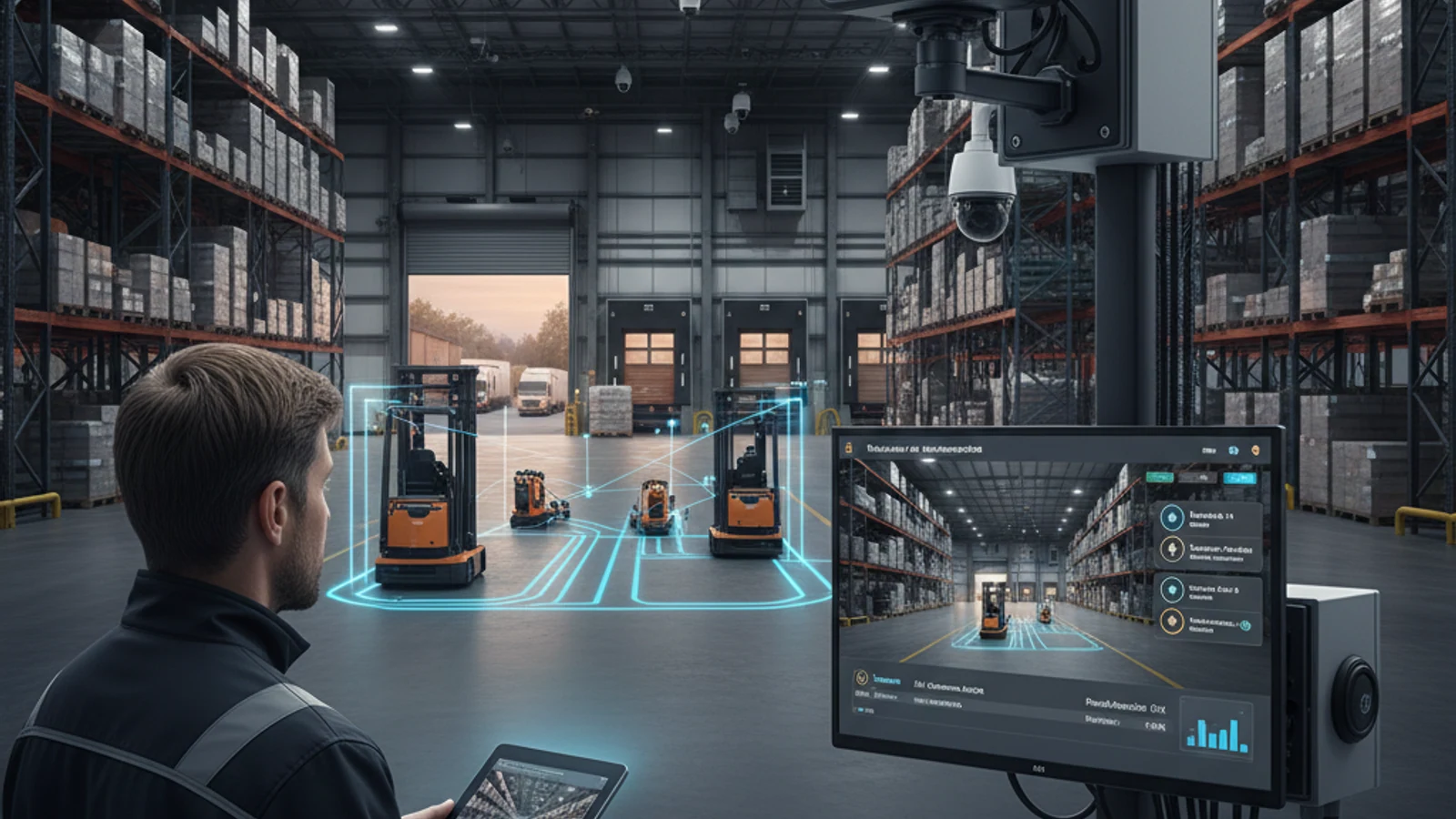
Warehouses present one of the most demanding environments for video surveillance: large footprints, limited sightlines, shift-based operations around the clock, high-value inventory at constant risk, and connectivity infrastructure that often lags behind urban commercial properties. Traditional NVR-based systems struggle here – they require hardware at every site, provide no remote visibility, and offer no operational intelligence beyond raw video footage.
Multi-site visibility
Give operations and security teams one place to monitor locations, users, and incidents.
AI-assisted review
Find events faster with video search, analytics, and alert workflows tied to real business needs.
Flexible deployment
Support existing cameras, cloud access, and hybrid recording for practical rollouts.
AI Cloud Surveillance Built for the Complexity of Warehouse Operations
Ifovea’s cloud-managed AI surveillance platform is designed specifically for the operational realities of warehouse and distribution center management – providing centralized visibility across all facilities, AI-powered incident investigation, and the local recording resilience that internet-dependent-only systems can’t guarantee.
The Unique Surveillance Challenges of Warehouses and Distribution Centers
Scale and Camera Density
Large warehouse facilities may require 50-200+ cameras to achieve adequate coverage across receiving docks, storage aisles, high-value pick zones, loading bays, parking lots, and perimeter areas. At this camera density, the cost and complexity of proprietary hardware platforms become significant – and the need for AI-powered forensic search rather than manual footage review becomes obvious.
Internet Connectivity Reliability
Warehouses located in industrial parks, rural distribution corridors, and older commercial facilities often have internet connections that are less reliable than urban office environments. A cloud surveillance architecture that stops recording when the WAN link drops is not viable for operations that require continuous monitoring and continuous recording for insurance and liability documentation.
Ifovea’s hybrid architecture records continuously to a local gateway at every facility, independent of internet connectivity. Footage syncs to the cloud for remote access, AI processing, and multi-site reporting – but a WAN outage causes no recording gap.
Inventory Theft and Shrinkage
Warehouse shrinkage is a significant operational cost. AI-powered surveillance enables faster and more effective shrinkage investigation by making forensic search practical – find a person carrying a specific item, locate a forklift in a specific aisle, or identify a vehicle at a loading dock – across your entire facility in minutes rather than hours.
Safety and Compliance Monitoring
OSHA compliance, PPE requirements, forklift safety zones, and hazardous materials areas all require consistent monitoring that human security teams can’t maintain continuously. AI-powered surveillance automates safety monitoring – detecting PPE violations, unauthorized personnel in restricted zones, and unsafe behaviors without requiring continuous human review of every camera feed.
Turn this into a practical surveillance plan
iFovea can review your camera fleet, sites, bandwidth, AI analytics needs, and migration path.
How Ifovea Serves Warehouse Operations
AI Forensic Video Search
When an incident occurs – theft, an accident, an inventory discrepancy – time spent reviewing footage manually is time lost. Ifovea’s AI forensic search lets your team find relevant footage by describing what they’re looking for: a specific forklift, a person in a red jacket, a vehicle at dock 12, a specific area of the facility at a specific time. Results across all cameras and all time windows appear in minutes.
Perimeter and Access Control Integration
Warehouses with after-hours activity present ongoing perimeter security challenges. Ifovea’s loitering detection and perimeter alert capabilities trigger proactive notifications when unauthorized activity is detected outside operating hours – before incidents occur rather than after.
License Plate Recognition (ALPR)
Track every vehicle entering and exiting your facility. Ifovea’s ALPR system logs and indexes all plates at entry and exit points, enabling post-incident investigation (what vehicles were on site during a theft?), access control validation (is this vehicle authorized to be here?), and operational efficiency analysis (how long do carrier vehicles wait at docks?).
PPE and Safety Compliance Monitoring
Automatically detect when workers in designated safety zones are not wearing required PPE – hard hats, high-visibility vests, safety glasses. Alert supervisors in real time or generate compliance reports for safety audits. Consistent monitoring eliminates the enforcement gaps that occur when safety officers can’t physically observe every zone continuously.
Multi-Facility Centralized Management
For logistics networks operating multiple distribution centers, Ifovea provides a single dashboard with visibility across all facilities. Corporate security teams can monitor any camera at any location, investigate incidents without traveling to the site, and maintain consistent security policies across the entire network from one platform.
Deployment Considerations for Warehouse Environments
- Hybrid architecture is strongly recommended for warehouses with unreliable internet – local recording ensures continuity regardless of WAN status
- PoE network infrastructure assessment before camera deployment – high-density camera installations require adequate switch capacity
- Wide-angle and panoramic cameras for aisle coverage – fewer cameras covering more space effectively reduces per-camera licensing cost
- Thermal cameras for perimeter coverage in low-light environments – integrates with Ifovea via ONVIF
- Camera positioning for ALPR requires specific installation angles and lighting at entry/exit points – Ifovea’s team provides site assessment for ALPR deployments
Industry Use Cases
- E-commerce fulfillment centers – High-throughput environments with significant shrinkage risk and strict operational efficiency requirements
- Cold storage and food distribution – Safety monitoring in low-temperature environments, HACCP compliance documentation
- Automotive parts distribution – High-value parts tracking, access control for restricted inventory areas
- Pharmaceutical distribution – Controlled substance area monitoring, DEA compliance documentation
- Third-party logistics (3PL) – Multi-client facility monitoring with client-specific access partitioning
Frequently Asked Questions
Can Ifovea handle a 200-camera warehouse facility?
Yes. Ifovea is designed for large-scale deployments. There’s no camera count limit at the site level, and the AI analytics – forensic search, ALPR, PPE detection – scale to operate across any number of cameras without performance degradation.
What happens to recording if our internet goes down?
With Ifovea’s hybrid architecture, nothing. The local gateway records continuously regardless of internet connectivity. Footage syncs to the cloud when connectivity is restored. Your recording history has no gaps due to WAN outages.
How does Ifovea integrate with our existing warehouse management system (WMS)?
Ifovea provides API access for integration with third-party systems including WMS platforms. Specific integration capabilities depend on your WMS API. Contact Ifovea’s team for a discussion of your specific integration requirements.
Can different team members access different camera areas?
Yes. Ifovea’s role-based access control allows granular permissions by camera, site, and time window. Safety managers can see safety zone cameras; HR can access areas relevant to incident investigation; dock supervisors see their dock area. Corporate security maintains full visibility across everything.
Get a Warehouse Surveillance Assessment
Ifovea’s team provides site assessments for warehouse and distribution center deployments – covering camera placement, network infrastructure, hybrid architecture planning, and AI analytics configuration for your specific operational requirements.
Related Resources
Frequently Asked Questions
What AI analytics are most useful for warehouse surveillance?
Top warehouse AI analytics: ALPR at dock doors (log every truck and driver entering/exiting), perimeter alerts for after-hours intrusions on the facility boundary, AI video search for rapid cargo incident investigation (find the forklift in the incident zone at the incident time), PPE compliance detection (hard hat and vest enforcement in active zones), and people counting at employee entrances for occupancy tracking.
Can cloud VMS handle 200+ cameras in a large distribution center?
Yes. Cloud VMS has no camera limit per account. Large distribution centers with 100–500 cameras are a common iFovea deployment. The pricing is linear per camera. For high camera counts, bandwidth planning is important: each 1080p camera requires 1–2 Mbps upload. A 200-camera facility needs 200–400 Mbps reliable upload — typically available via business-grade fiber.
How does cloud VMS work with warehouse management systems (WMS)?
iFovea does not have a native WMS integration, but cloud VMS complements WMS operations: when WMS logs a discrepancy (shrink, damaged goods, mis-picks), operations uses the timestamp and dock or aisle to pull up the camera footage in iFovea AI video search for rapid investigation. This video-corroborated exception review workflow is standard in high-volume distribution environments.
Can surveillance cameras monitor forklift safety compliance?
Yes. Zone alerts and PPE compliance detection support forklift safety: configure zones around pedestrian walkways that generate an alert when a forklift enters, PPE detection for operators (hard hat, high-vis vest), and AI video search to review any incident involving a forklift in a specific location and time window. For advanced forklift proximity detection (detecting proximity to pedestrians in real time), specialized edge AI hardware is required beyond standard cloud VMS.
How does warehouse cloud surveillance help with cargo theft investigation?
AI video search dramatically accelerates cargo theft investigation: rather than reviewing hours of dock camera footage manually, investigators describe the incident (truck, time window, dock number) and AI returns the relevant clips in seconds. ALPR at dock doors logs every truck with timestamp and plate, creating a searchable access log. These two capabilities together — searchable entry records + searchable footage — typically reduce investigation time from hours to minutes.
Can cloud VMS cover outdoor yard and perimeter areas in a warehouse?
Yes. Outdoor yard and perimeter cameras connect to iFovea the same as indoor cameras, provided they have network connectivity (wired or cellular). For remote yard areas without network infrastructure, cellular-connected cameras or edge recording gateways with cellular backup are used. Perimeter alert AI works on outdoor cameras with appropriate lighting (IR cameras for night coverage).
What camera resolution is recommended for warehouse surveillance?
Recommended: 1080p (Full HD) for general area coverage, 4K for dock doors and high-value areas where plate or face detail matters for investigations. Fisheye 360° cameras are effective for high-bay areas where a single camera must cover a large floor section. PTZ cameras are useful in yards where active monitoring is performed. For AI analytics (ALPR, PPE detection), 1080p minimum is required; 4K improves accuracy.
Does warehouse surveillance work across multiple distribution center locations?
Yes. Multi-site cloud VMS centralizes all DC locations on one dashboard. Operations managers see their assigned DCs; regional directors see all locations; corporate security sees the full network. AI video search and ALPR logs work across all locations from one interface — valuable for investigations involving a specific carrier or driver across multiple facilities.
How does cloud surveillance integrate with access control at warehouse gates?
ALPR at warehouse vehicle gates creates an automatic vehicle access log — every truck entering and exiting is logged with plate number and timestamp. This can be compared against your carrier schedule and manifest. For pedestrian access control, ONVIF-compatible door controllers can be integrated with iFovea for a correlated footage + access event record. Full access control database integration requires an additional access control system.
What is the cost of surveillance for a 500,000 sq ft distribution center?
A 500,000 sq ft distribution center typically needs 80–150 cameras depending on layout. At $20/camera/month: 100 cameras = $2,000/month or $24,000/year. This includes cloud storage, all AI analytics (ALPR, PPE compliance, zone alerts, AI video search), and multi-site management. For comparison, a local NVR system at this scale requires $15,000–$30,000 in server hardware, $2,000–$5,000/year HDD replacement, and ongoing IT labor.
Related resources
Continue comparing options, planning migration, and estimating the right cloud surveillance architecture.
Related Platform Features, Industries & Comparisons
Platform features, similar industries, competitor comparisons, and cost tools
Platform Features
Related Industries
Compare Alternatives
Ready to plan the next step?
iFovea can review your camera fleet, sites, bandwidth, AI analytics needs, and migration path.