

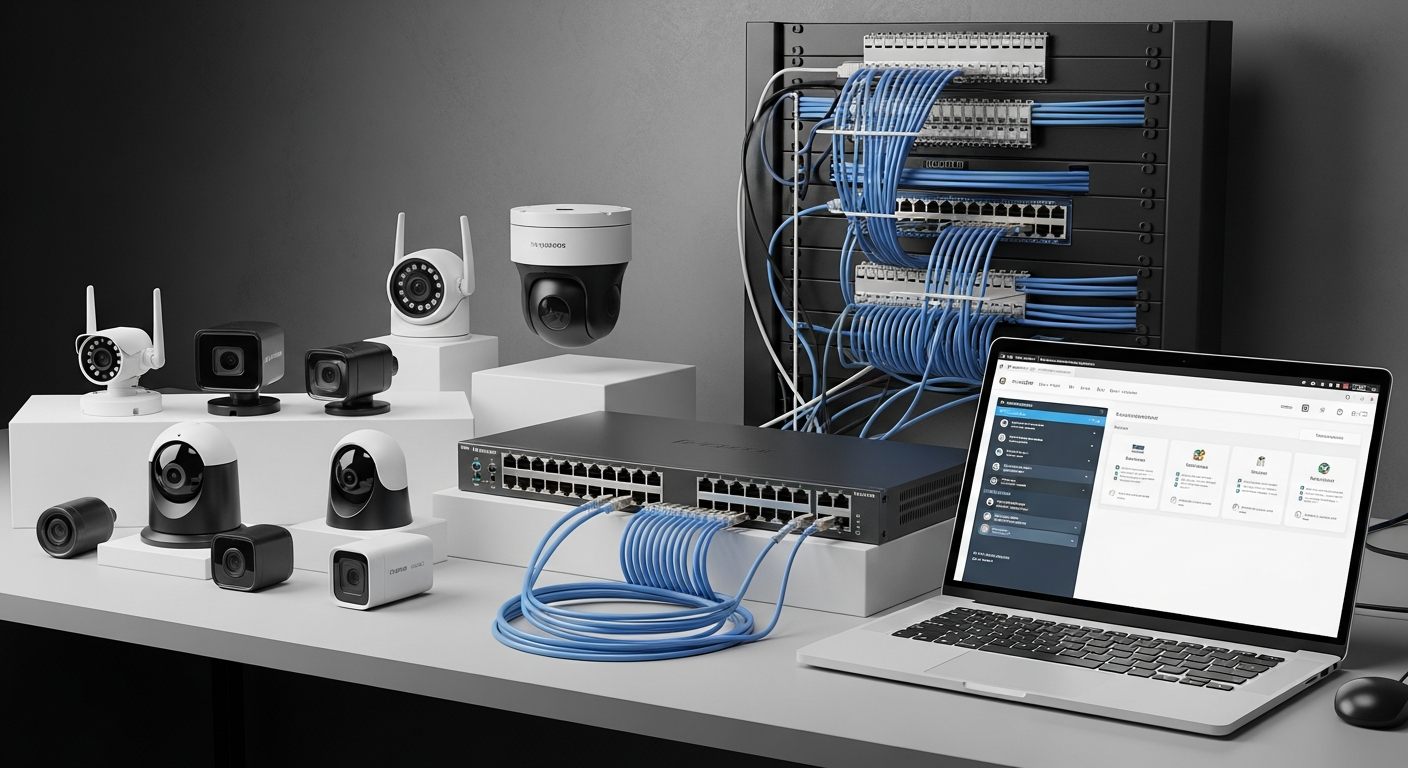
A cloud VMS platform’s value is not determined by the cameras it sells — it’s determined by the cameras, access control systems, alarm platforms, and operational tools it works with. iFovea is built on an open architecture designed to integrate with existing security infrastructure rather than replace it.
This page documents iFovea’s compatibility ecosystem: the IP camera manufacturers whose cameras connect to the iFovea platform, the protocol standards that enable open connectivity, and the integration categories that allow iFovea to work alongside access control, alarm monitoring, business intelligence, and operational technology already deployed in your facilities.
IP Camera Compatibility
iFovea supports IP cameras from all major manufacturers through open protocol standards. Cameras do not need to be purchased from iFovea or replaced to connect to the platform — any ONVIF-compatible or RTSP-streaming IP camera installed in the past decade can connect through the iFovea Gateway.
Supported Camera Manufacturers
Compatibility depends on the camera supporting ONVIF Profile S/G/T or RTSP streaming. Most commercial IP cameras installed in the past 8–10 years are compatible. Use the camera compatibility guide to check your specific models.
Protocol Standards That Enable Open Connectivity
ONVIF (Open Network Video Interface Forum)
ONVIF is the industry standard protocol for IP security camera interoperability. ONVIF Profile S defines streaming, PTZ, and event capabilities; Profile G defines recording and retrieval; Profile T defines advanced streaming including H.265 and metadata. Most professional IP cameras manufactured since 2010 support ONVIF, making them compatible with the iFovea platform without any camera-side modification.
RTSP (Real-Time Streaming Protocol)
RTSP is the underlying streaming protocol used by most IP cameras to deliver video streams to VMS platforms. Cameras that support RTSP streaming — even if they don’t fully implement ONVIF — can typically connect to iFovea through direct RTSP stream configuration in the platform.
Webhook and API Integration
iFovea supports inbound webhooks for event data from compatible third-party systems — access control events, alarm system triggers, POS transaction data — enabling correlation of external events with camera footage and AI analytics data. Outbound webhook notifications allow iFovea AI events to trigger actions in connected operational systems.
Integration Categories
Access Control and Physical Security
Camera footage and AI analytics become significantly more powerful when correlated with access control events. When a door access event occurs — badge scan, credential failure, forced entry alarm — correlating the access event timestamp with footage from cameras at that entry point provides immediate investigative context. iFovea’s event timeline and AI search capabilities support this correlation workflow through the video portal.
Alarm Monitoring Platforms
Security monitoring centers and alarm receiving centers (ARCs) can integrate with iFovea to receive AI-generated video event data alongside traditional alarm signals. When an alarm triggers, the monitoring station receives the AI event context — what was detected, when, at which camera — enabling video-verified alarm response rather than blind dispatch decisions. See the alarm monitoring portal for video verification workflow capabilities.
Business Intelligence and Operational Data Systems
AI analytics data generated by iFovea — people counts, occupancy metrics, vehicle presence, heat map data, dwell times — can be exported or accessed via API for integration with business intelligence platforms, workforce management systems, and operational dashboards. Retail analytics teams use this data for store performance analysis; operations teams use it for workflow optimization.
IoT and Building Automation
IoT devices, building management systems, and environmental sensors can send event triggers to iFovea via webhook, correlating environmental events (temperature alarm, door open sensor, occupancy sensor) with camera footage from the relevant zone. This integration capability is particularly relevant for industrial, manufacturing, and critical infrastructure deployments.
IP Audio and Two-Way Communication
IP audio systems compatible with network-based audio streaming can be integrated with camera views in the iFovea portal for facilities that require two-way audio capability alongside video monitoring — relevant for access control stations, lobby monitoring, and remote guarding applications where operator-to-visitor communication is a workflow requirement.
The Open Architecture Advantage
| Approach | Proprietary Ecosystem (Verkada, Rhombus) | iFovea Open Architecture |
|---|---|---|
| Camera compatibility | Manufacturer’s cameras only | 500+ ONVIF/RTSP compatible models |
| Hardware replacement | Required when platform changes | Not required — cameras stay when platform changes |
| Third-party integrations | Limited to approved partner ecosystem | Open API, webhooks, ONVIF, RTSP |
| Switching cost | Camera replacement + new hardware | Gateway replacement only — cameras remain |
Frequently Asked Questions
Does iFovea require cameras to be purchased from specific vendors?
No. iFovea is compatible with cameras from any manufacturer that supports ONVIF or RTSP protocols. This includes all major IP camera brands — Hikvision, Axis, Uniview, Hanwha, Milesight, Dahua, Vivotek, TVT, Tiandy, 2M Technology, and hundreds of other brands with ONVIF support. Cameras do not need to be purchased from iFovea or any specific vendor to connect to the platform.
How do I confirm my existing cameras are compatible?
Check whether your cameras support ONVIF Profile S, Profile G, or Profile T, or whether they have an RTSP stream URL (found in the camera’s network settings or documentation). Most professional IP cameras installed in commercial environments over the past decade are compatible. The BYOC camera compatibility guide provides detailed compatibility information by brand and model.
Can iFovea integrate with our existing access control system?
Access control integration is supported through API and webhook connectivity for platforms that offer outbound event notification. Contact the iFovea team through the demo request form to discuss your specific access control platform and integration requirements.
Is an API available for custom integrations?
iFovea provides API access for custom integrations. API key generation and management is handled through the admin portal. Contact the iFovea team to discuss API documentation and integration scope for specific use cases.
Does iFovea have formal technology partner agreements with camera manufacturers?
iFovea’s compatibility is based on open protocol standards (ONVIF, RTSP) rather than formal OEM partner agreements. This means compatibility is determined by the camera’s protocol support, not by a specific vendor relationship. As the ONVIF standard continues to evolve, cameras that support current ONVIF profiles remain compatible with the platform without requiring formal partnership agreements with camera manufacturers.
Related Resources
- Bring Your Own Camera (BYOC): Open Camera Compatibility Guide
- iFovea Gateway: Cloud Connection for Existing Cameras
- Cloud VMS Platform Guide
- Alarm Monitoring Portal: Video-Verified Alarm Response
- Admin Portal: API Key Management and Integration Configuration
Check Your Camera and Integration Compatibility
Request a demo to verify your existing cameras are compatible with iFovea and discuss integration options for your access control, alarm monitoring, or operational technology systems.
Looking to join iFovea as a partner?
Apply for early access to the iFovea Partner Program — partner pricing, deal registration, and a multi-tenant dashboard for every client.