

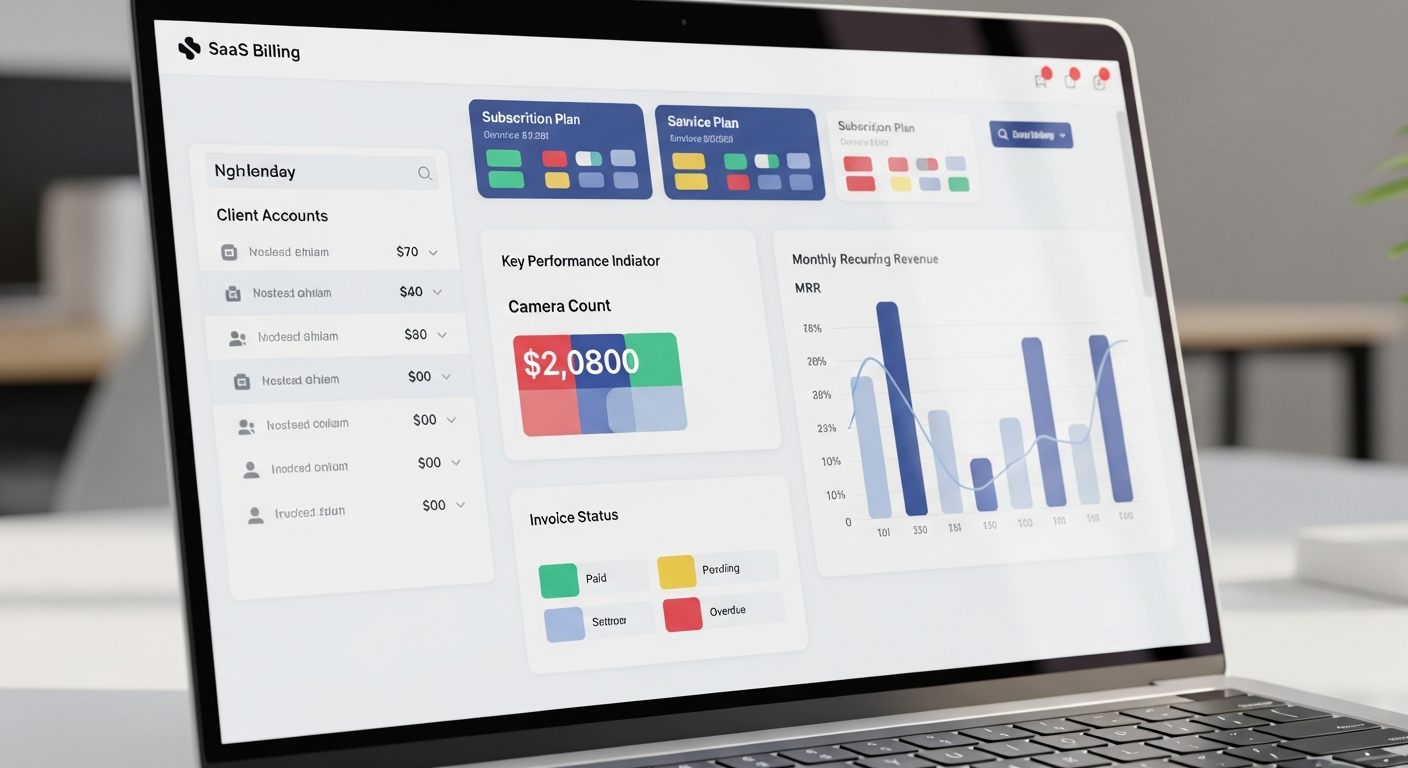
Security integrators who built their business on hardware margin face a structural challenge as the industry moves to cloud: recurring revenue models require billing infrastructure that hardware distribution never needed. Camera sales closed a project. VSaaS subscriptions require monthly billing, plan tracking, consumption monitoring, and client invoicing — a fundamentally different operational model.
The iFovea VSaaS Billing Module gives security integrators and white-label VMS partners the billing infrastructure to operate a recurring revenue surveillance business — per-customer plan tracking, camera count management, storage consumption visibility, subscription lifecycle management, and professional services billing — without building a custom billing system or relying on generic invoicing software that doesn’t understand camera plans.
What VSaaS Billing Requires That Generic Billing Software Doesn’t Solve
Standard invoicing tools work for fixed-price services. VSaaS billing has characteristics they aren’t built for:
- Camera-count-based pricing — subscriptions are priced per camera, and camera counts change as clients add or remove cameras. Billing must reflect the current camera count at each billing cycle, not a fixed contract price from the installation date.
- Plan tier management — clients may be on Essential, Professional AI, or Enterprise plans with different feature sets. When a client upgrades plans mid-cycle, proration, feature activation, and billing adjustment need to happen in a coordinated sequence.
- Add-on tracking — ALPR, advanced AI analytics, extended retention, and professional services may be billed as add-ons to base plans. Tracking which clients have which add-ons at which pricing requires subscription-aware billing rather than generic line items.
- Multi-tier client structures — integrators with sub-integrators or dealer networks may need to manage billing for their own clients while maintaining visibility into their upstream costs — a hierarchy that flat billing tools don’t accommodate.
VSaaS Billing Module Capabilities
Per-Customer Subscription Management
Track each client’s subscription plan, camera count, retention policy, and add-ons. View subscription status, renewal dates, and billing history per customer from a single administrative interface.
Camera Count and Plan Tracking
Camera count is automatically tracked against each customer’s subscription. When cameras are added or removed, the billing module reflects the updated count for accurate recurring revenue calculation.
Storage and Usage Visibility
Monitor cloud storage consumption per customer and per location. Usage data supports accurate billing for storage-tier plans and helps identify customers who may need retention policy adjustments or plan upgrades.
Add-On and Professional Services
Track add-on subscriptions (ALPR, extended retention, advanced AI tiers) and professional services engagements (installation, configuration, training) alongside base plan billing for complete client account visibility.
Recurring Revenue Reporting
Monthly recurring revenue (MRR) and annual recurring revenue (ARR) summaries across the full customer base. Track revenue growth, churn, and plan distribution to manage the VSaaS business by the metrics that recurring revenue models require.
Billing History and Documentation
Complete billing history per customer with invoice documentation for client records, contract renewals, and account disputes — accessible without dependency on third-party payment processors’ reporting tools.
The VSaaS Recurring Revenue Model for Integrators
The economics of VSaaS are structurally superior to pure hardware installation — but only for integrators who operationalize the recurring revenue model correctly. The billing module is the infrastructure that makes it operational:
| Business Model | Hardware-Only Installation | VSaaS Recurring Revenue |
|---|---|---|
| Revenue timing | Lump sum at installation | Monthly/annual subscription |
| Customer retention | Competitive on next project | Ongoing service relationship |
| Revenue predictability | Project-dependent | Predictable MRR/ARR |
| Revenue per camera | One-time hardware margin | Annual subscription margin per camera |
| Billing infrastructure | Standard invoicing | Camera-plan-aware billing module |
An integrator with 50 clients and an average of 20 cameras per client at $20/camera/month has $20,000 MRR — predictable, recurring, and growing as clients add cameras rather than dependent on new project wins.
Who the VSaaS Billing Module Serves
Security Integrators Building a VSaaS Practice
Integrators transitioning from hardware-based business models to VSaaS need billing infrastructure from day one. The billing module eliminates the need to manage camera-count-based pricing in generic invoicing software — where every plan change requires manual invoice adjustment — and replaces it with subscription-aware tracking aligned to how VSaaS is actually priced.
White-Label VMS Partners
For white-label VMS partners building a branded cloud surveillance business, the billing module provides the client account management layer needed to operate a multi-client VSaaS business. Partners can track each client’s subscription, usage, and billing history while maintaining their own branded service relationship with the client.
Managed Service Providers Expanding into Video
IT managed service providers (MSPs) adding cloud video surveillance to their service catalog need billing that integrates their existing client relationships with camera-count-based VSaaS pricing. The billing module supports this integration without requiring MSPs to build custom billing infrastructure for a new service line.
Frequently Asked Questions
Does the billing module automatically update camera counts when cameras are added or removed?
Camera counts in the billing module reflect the cameras configured in the platform for each customer account. When cameras are added or removed through the admin portal, the billing module’s camera count tracking updates accordingly, providing accurate subscription utilization data for billing cycle calculations.
Can the billing module be used with white-label VMS deployments?
The VSaaS billing module is part of iFovea’s partner program infrastructure. White-label VMS partners should discuss billing module configuration and client account structure with the iFovea partner team during the partner onboarding process.
What happens to billing visibility if a customer cancels their subscription?
Billing history for cancelled customer accounts remains accessible in the admin portal for the period required for record-keeping and dispute resolution. Customer data and footage access terms post-cancellation are defined in the subscription agreement.
Is the billing module available to all iFovea resellers?
VSaaS billing capabilities are part of iFovea’s partner and reseller program. Specific billing module access and configuration is established during the partner program onboarding process. Contact the iFovea team through the partner inquiry form to discuss program eligibility and billing module access.
Related Resources
- White-Label VMS: Build Your Own Cloud Surveillance Brand
- Admin Portal: Centralized User and Camera Management
- Cloud VMS Pricing: Plans and Camera-Count Tiers
- VSaaS Reseller Program Guide for Security Integrators
- Cloud VMS for Security Integrators
Explore iFovea White-Label VMS and VSaaS Billing
Talk to the iFovea partner team about building a VSaaS recurring revenue practice with the billing infrastructure, white-label platform, and integrator support to operate it at scale.
Looking to join iFovea as a partner?
Apply for early access to the iFovea Partner Program — partner pricing, deal registration, and a multi-tenant dashboard for every client.