

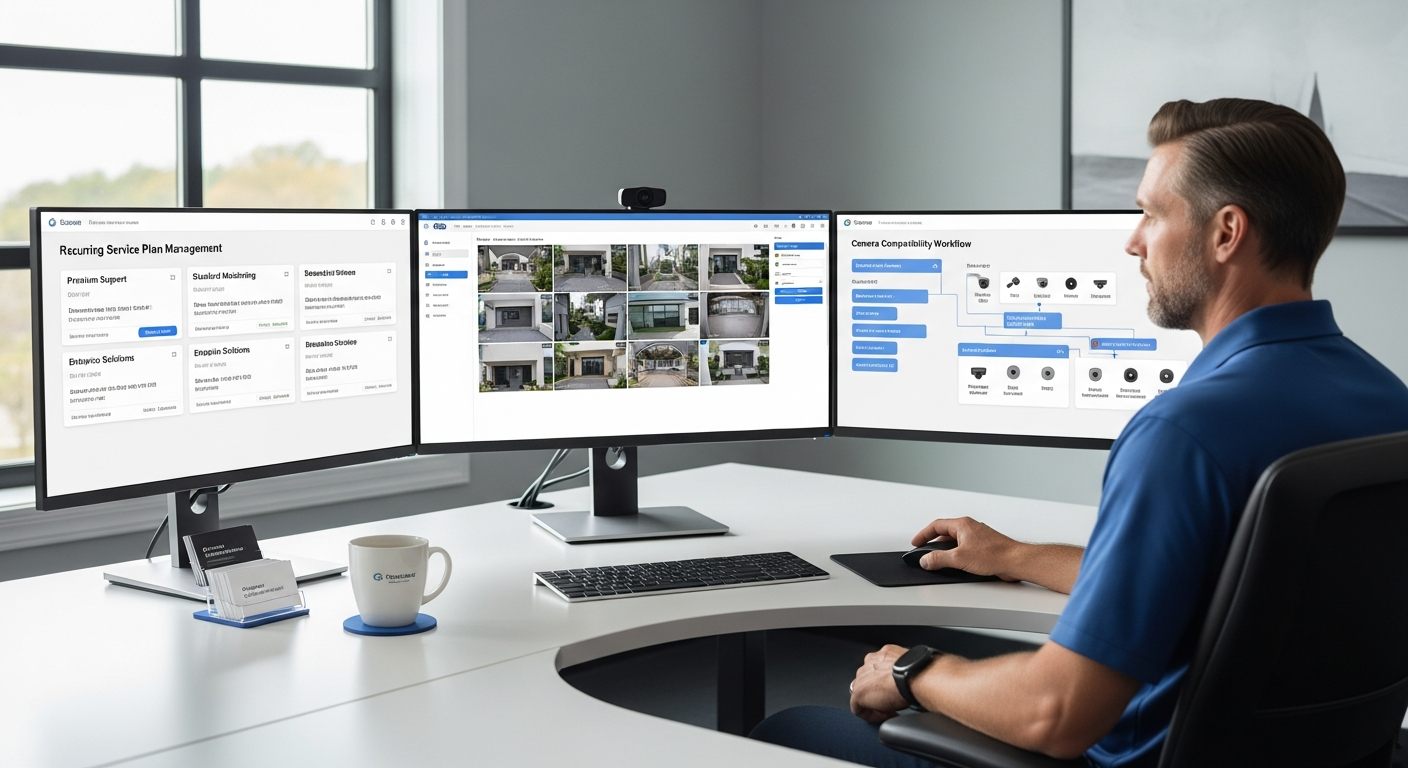
If you’ve spent the past decade installing Hikvision, Dahua, or OEM camera systems for commercial customers, you understand those systems better than almost anyone. You know the brands, the models, the limitations, the wiring, and what your customers are worried about. That knowledge is exactly what you need to become your customers’ cloud VMS migration partner — before a competitor does it for you.
Your existing camera customers are already asking questions about their Hikvision or Dahua systems. About the FCC restrictions. About whether they need to replace everything. About getting remote access to footage they currently can only see on-site. If you’re not offering them a cloud upgrade path, those conversations lead to proposals from competitors who will.
iFovea’s cloud VMS platform and white-label VMS program give security integrators a platform to convert legacy NVR customers into recurring cloud revenue — using the camera expertise and customer relationships you’ve already built.
Why Your NVR Customers Are Ready for a Cloud Upgrade
Every Hikvision or Dahua NVR customer you installed 3–8 years ago is now operating a system that:
- Has no reliable remote access — they’re still driving to locations to pull footage or relying on unstable DDNS connections
- Has no AI analytics — no people counting, no AI video search, no ALPR, no behavioral alerts
- Has NVR hardware approaching or past its replacement window — hard drives fail, power supplies fail, manufacturers are no longer shipping compliant replacement units
- Has no role-based access controls — any user with access sees everything, and there’s no audit trail
- Has no multi-site visibility — if they have 5 locations, they have 5 separate systems with no unified view
- May have growing concerns about the Hikvision/Dahua regulatory environment that they can’t fully evaluate themselves
All of these are problems you can now solve. Cloud VMS addresses every one of them. The question is whether you have the platform to deliver it.
The Vulnerability: NVR Customers Churn to Proprietary Platforms
The companies your NVR customers are most likely to encounter when they start searching for solutions are Verkada, Rhombus, and similar proprietary cloud camera platforms. These companies are well-funded, heavily marketed, and pitch a single-vendor solution that requires replacing all existing cameras with their proprietary hardware.
If a customer replaces their existing camera system with Verkada’s cameras and cloud platform, they no longer need you. They’re locked into a proprietary hardware-software ecosystem with a direct vendor relationship. You’ve lost the account — and the recurring revenue that should have been yours.
The alternative: offer a cloud upgrade path that works with the cameras you already installed. You stay in the relationship. You provide the cloud VMS layer. You maintain the recurring revenue that hardware margin no longer delivers.
How to Convert Legacy NVR Customers to Cloud VMS Recurring Revenue
Step 1: Camera Compatibility Assessment
Most commercial Hikvision, Dahua, and OEM cameras installed in the past 8–10 years support ONVIF or RTSP protocols. A compatibility assessment — which iFovea can assist with — determines which cameras at each customer site are compatible with cloud VMS migration. Use the camera compatibility guide to pre-screen your installed base.
Step 2: Compliance Screening
For each customer, determine whether they have federal contracting relationships, receive federal grants, or have other compliance obligations. For private commercial customers with no federal relationships, camera reuse may be technically viable. For customers with federal obligations, recommend full camera replacement with NDAA-compliant hardware — iFovea cloud VMS works with compliant cameras from all major manufacturers. Be clear: iFovea does not make restricted cameras compliant.
Step 3: Present the Migration Proposal
The conversation with your customer is:
“Your cameras may still have years of useful life. What doesn’t have useful life is your NVR — it’s limiting your visibility, your security posture, and your ability to use AI analytics on the camera investment you’ve already made. We can move your compatible cameras to a cloud VMS platform that gives you remote access from any device, AI video search, people counting, ALPR, and multi-site visibility — without replacing cameras that are working.”
Step 4: Deliver the Gateway Installation
The iFovea Gateway installation connects to the existing PoE switch where cameras are already wired. No new cabling required. Most locations can be operational on cloud VMS in 2–4 hours of installation time. The NVR can be decommissioned once the Gateway is running and the customer has validated cloud access.
Step 5: Establish the Recurring Service Relationship
Cloud VMS subscriptions are per-camera per-month. You set the retail price. iFovea’s wholesale pricing gives you margin to build a profitable managed service offering. A customer with 24 cameras at $20/camera/month is $480 MRR per customer — recurring, predictable, and growing when they add cameras.
The Recurring Revenue Math
| Scenario | Cameras | Monthly Revenue | Annual Revenue |
|---|---|---|---|
| 10 customers × 20 cameras avg | 200 | $4,000 | $48,000 |
| 25 customers × 20 cameras avg | 500 | $10,000 | $120,000 |
| 50 customers × 30 cameras avg | 1,500 | $30,000 | $360,000 |
| 100 customers × 40 cameras avg | 4,000 | $80,000 | $960,000 |
Illustrative estimates at $20/camera/month example retail pricing. Actual pricing, margins, and plans vary. See iFovea pricing for current plan details.
iFovea White-Label VMS: Your Brand, Your Platform
For integrators who want to build a branded cloud surveillance business rather than reselling iFovea under the iFovea brand, the white-label VMS program provides the platform infrastructure under your brand:
- Your logo, your brand colors, your portal domain
- Your customer accounts, isolated and managed through the partner admin portal
- Your pricing — you set retail rates and retain the margin above wholesale
- VSaaS billing module for per-customer plan tracking and subscription management
- Full AI analytics platform included — ALPR, people counting, AI video search, behavioral detection
- Same camera compatibility — 500+ ONVIF models from all major manufacturers
Camera Knowledge You Already Have
One undervalued asset in the cloud VMS migration conversation is what integrators already know about their customers’ camera infrastructure. You know:
- Which camera models are installed at each site
- The network architecture, PoE switch locations, and cable runs
- The age and condition of existing equipment
- Which sites have bandwidth constraints that require hybrid cloud architecture
- Which customers have federal contracting relationships that change the compliance calculus
This knowledge makes you a better cloud VMS migration partner than any direct-sales rep from a platform vendor who’s never seen your customers’ sites. Use it.
Compliance Guidance for Integrators
When presenting cloud VMS migration options to customers with Hikvision or Dahua equipment:
- Always ask whether the customer has federal contracts, receives federal grants, or is subject to specific regulatory compliance requirements
- For customers with federal relationships: recommend full camera replacement with NDAA-compliant hardware; iFovea cloud VMS supports the compliant new infrastructure
- For private commercial customers: camera reuse may be technically viable; disclose that iFovea does not make restricted cameras NDAA compliant and that camera reuse should be reviewed against the customer’s specific situation
- Document the compliance discussion in your project records
Frequently Asked Questions
Can I resell iFovea cloud VMS under my own brand?
Yes. iFovea’s white-label VMS program allows integrators to deliver cloud surveillance under their own brand. Contact the iFovea partner team through the partner inquiry form to discuss program eligibility and setup.
Does iFovea support hybrid deployments where some cameras are new and some are legacy?
Yes. iFovea’s platform supports mixed camera deployments — new NDAA-compliant cameras alongside compatible existing cameras, all managed from the same cloud dashboard. This is ideal for phased migration projects where customers replace cameras progressively while maintaining visibility across the full installation.
What training does iFovea provide for integrators?
iFovea provides deployment documentation, camera compatibility resources, and partner onboarding support. Contact the partner team for specific training program details.
Can I manage all my customer accounts from a single dashboard?
Yes. The admin portal supports multi-tenant management — you can view and manage all your customer accounts, configure their camera systems, and monitor system health across your entire installed base from a single interface.
Related Resources
- White-Label VMS: Build Your Cloud Surveillance Brand
- VSaaS Billing Module: Recurring Revenue Management
- VSaaS Reseller Program Guide
- NVR Replacement Guide for Existing Camera Customers
- NDAA Compliance Migration Guide
- Cloud VMS Pricing and Partner Plans
Explore iFovea Cloud VMS for Your Integration Business
Talk to the iFovea partner team about converting your existing camera customers to cloud VMS recurring revenue — white-label options, partner pricing, and the deployment workflow that turns your camera expertise into a managed cloud service.
Looking to join iFovea as a partner?
Apply for early access to the iFovea Partner Program — partner pricing, deal registration, and a multi-tenant dashboard for every client.