

iFovea vs Frigate NVR
Cloud AI analytics vs. Home Assistant NVR — when GPU-accelerated local detection makes sense and when cloud VMS is the right next step.
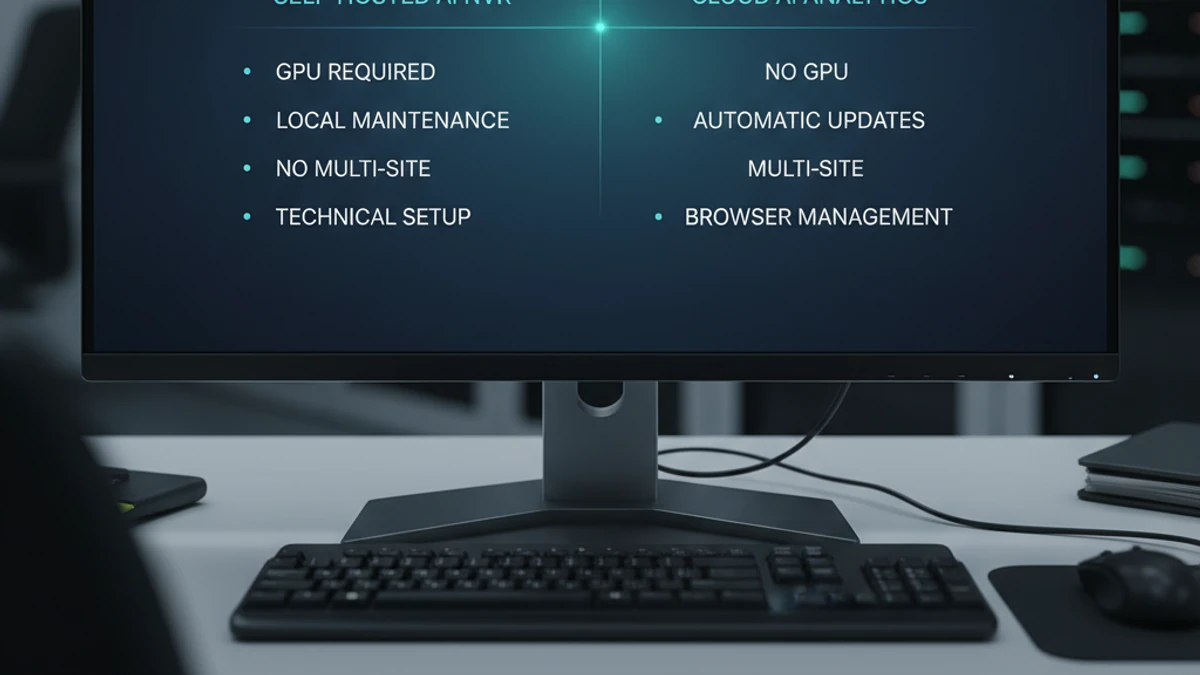
🏠 Frigate NVR — Best When
- Home or small residential use
- Home Assistant already deployed
- Developer / technical user
- Privacy-first, no cloud data
- GPU or Coral TPU hardware available
- MQTT/webhook automation required
- Budget is the primary driver
🏢 iFovea — Best When
- Commercial / enterprise deployment
- Multiple sites to manage centrally
- Non-technical staff accessing cameras
- ALPR, people counting, AI search needed
- No on-site GPU infrastructure
- Compliance audit logging required
- Integrator managing multiple customers
What Frigate NVR Does Exceptionally Well
Frigate is technically impressive. It runs in Docker, integrates deeply with Home Assistant, and delivers real-time AI object detection at a fraction of the cost of proprietary smart camera systems.
Local AI Without Subscription
Person, car, animal, and package detection using TensorFlow Lite models, with no per-event cloud cost. Runs entirely on your hardware.
Google Coral TPU Support
The Coral Edge TPU processes 50+ inferences per second at just 4W of power, dramatically reducing CPU load vs. software-only detection.
NVIDIA GPU Acceleration
CUDA-accelerated inference for larger deployments or multiple simultaneous streams. Scales up to RTX 4090 for high camera counts.
Real-Time MQTT Events
Instantly triggers Home Assistant automations, notifications, scripts, and integrations the moment a detection fires — deep HA ecosystem integration.
Active Development
GitHub releases consistently, active Discord, extensive documentation, rapid feature iteration. The community is genuinely excellent.
Sub-Stream Efficiency
Uses low-resolution sub-streams for detection and high-resolution main streams for recording — efficiently using GPU resources without saturating bandwidth.
Feature Comparison Table
The Frigate GPU Requirement in Practice
Frigate’s AI detection quality is directly proportional to the inference hardware available. Without hardware acceleration, Frigate falls back to CPU-only inference — manageable for 1–2 cameras but impractical for larger deployments.
☁️ iFovea: No On-Site GPU Needed
For iFovea, there is no local GPU requirement. AI inference runs in the cloud regardless of camera count. A 100-camera enterprise deployment uses the same gateway device as a 5-camera site.
Why Frigate Users Upgrade to Cloud VMS
The Frigate community is technically sophisticated. Users who move to cloud VMS aren’t doing it because Frigate is difficult — they’re doing it because:
Business Use Requires Audit Trails
When footage is used for insurance claims or legal matters, a proper audit trail of who accessed what footage is essential. Frigate has no access logging.
Multiple Locations Don’t Scale
A second Frigate instance at a second location means a second server, second Docker deployment, second VPN. There’s no multi-site unified management in Frigate.
Non-Technical Staff Need Access
When the restaurant manager needs to check footage on a Monday morning, they need something simpler than a Docker-hosted web UI behind a VPN.
Hardware Maintenance Is Burden
Coral TPU availability has been inconsistent. GPU pricing fluctuates. When inference hardware fails, AI stops working. Cloud AI has no single point of hardware failure.
Scaling Beyond What Frigate Handles Well?
Tell us about your deployment — sites, camera count, AI analytics needs. We’ll tell you honestly if cloud VMS is the right next step.
FAQ
The True Cost of Running Frigate NVR: What “Free” Actually Costs
Frigate NVR software: free. The GPU and server it needs for AI: not free.
The software license is the smallest item in your total cost. The real costs are infrastructure: the server that runs it, the electricity that powers it, the storage that holds footage, the IT time that keeps it running, and the remote access tools required to view it from anywhere. Here is what 10 cameras on a self-hosted VMS actually costs per month.
Self-Hosted VMS (10 cameras, conservative)
$8–$27 / camera / month
Infrastructure + labor. Software license not the main cost.
- No native AI analytics (people counting, ALPR, forensic search)
- No multi-site dashboard
- Remote access requires VPN or cloud relay setup
- You are responsible for uptime, backups, and recovery
iFovea Cloud VMS (10+ cameras)
Contact for per-camera quote
One line item. Infrastructure, AI, and maintenance included.
- 10 AI analytics types included: ALPR, people counting, forensic search, heat maps, and more
- All sites on one dashboard
- Native mobile app remote access — no VPN required
- Cloud infrastructure managed and monitored by iFovea
The honest math
For organizations with a dedicated sysadmin who manages many other systems (where surveillance is a minor time allocation), self-hosted VMS can make sense. For businesses paying someone to manage surveillance infrastructure specifically — or where IT time has opportunity cost — cloud VMS is often cheaper on a per-camera basis when all costs are counted. Use the NVR Replacement ROI Calculator to model your specific deployment.
Open-Source VMS Resource Center
Compare platforms, estimate costs, and plan your migration
Blue Iris Alternative
ZoneMinder Alternative
Shinobi Alternative
NX Witness Alternative
Self-Hosted VMS Security Risks
GPU Requirements for AI Surveillance
VPN vs Cloud Remote Access
Migrate Blue Iris to Cloud VMS
Edge Recording vs Cloud Recording
NVR Replacement ROI Calculator
Centralized Camera Management